





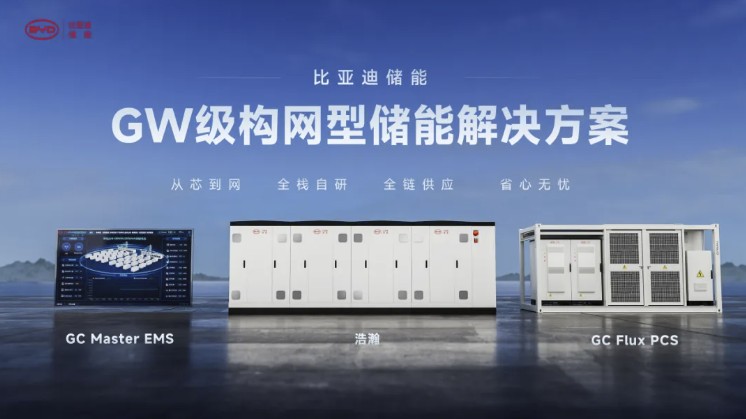
BYD has unveiled “HaoHan,” a new DC energy storage system with the world’s largest single-unit capacity of 14.5 MWh. The launch took place on September 18 at the International Digital Energy Expo in Shenzhen.
The company says the system more than doubles today’s industry norm of 6–7 MWh. Packaged in a standard 20-foot container, HaoHan delivers 10 MWh and achieves an energy density of 233 kWh per cubic meter—about 51% higher than the average. BYD claims that for a 1 GWh project, HaoHan can cut required units by half, shrink land use by one-third, and reduce cell count by 76%.
At the core of the system is BYD’s self-developed 2,710 Ah Blade Battery cell, which it calls the largest storage cell in the world. “This next-generation cell delivers three times the capacity of conventional products and can last for more than 10,000 cycles,” a BYD spokesperson said. The company estimates lifecycle costs at less than CNY 0.1 ($0.014) per kWh.
HaoHan achieves a 52% volumetric cell-to-system efficiency through an integrated design that removes redundant components. Built for harsh conditions—from deserts to coastal zones—the system promises a 70% drop in failures and maintenance costs. With BYD’s in-house power conversion system and management software, it can respond within milliseconds and provide grid-forming services at gigawatt scale.
The company expects HaoHan to lower project-level levelized costs (LCOS) by 21.7% and trim procurement, transport, and installation costs by around 30% for a typical 1 GWh plant. Target uses include renewable energy integration, grid balancing, and large-scale backup.
BYD also highlighted the system’s environmental edge. HaoHan features blockchain-based carbon tracking and, according to the company, has an 18% lower carbon footprint than the industry norm—an advantage for meeting EU carbon border rules.
The launch comes as global competition heats up. CATL introduced its 9 MWh TENER Stack earlier this year, Tesla rolled out a 20 MWh Megablock, and Sungrow released its 6.9 MWh PowerTitan 3.0. BYD plans to deploy HaoHan across several gigawatt-scale projects by late 2025, including a landmark 12.5 GWh plant in Saudi Arabia.
Looking forward, BYD says it is working on liquid cooling, predictive maintenance, and hybrid solar-hydrogen-storage systems. The goal is to push efficiency beyond 95% by 2026.
Alongside HaoHan, the company launched its GC Flux grid-forming inverter, covering 2.5–10 MW. BYD says the inverter delivers 38% better performance than standard models, with a record power density of 1,474 kW/㎡—130% higher than typical values. It supports 3x overload for up to 10 seconds and reaches 99.35% peak efficiency.
The GC Flux PCS is designed for modern grids. It enables fast inertia response, wide-band damping, and ultra-quick voltage and frequency regulation. “This is about stability in renewable-heavy networks,” the company noted.
Rounding out the launch, BYD introduced the GC Master EMS, a platform for controlling ultra-large storage projects. It can handle up to 10 million data points and manage stations of up to 15 GWh capacity—four times the computing power of conventional systems.