





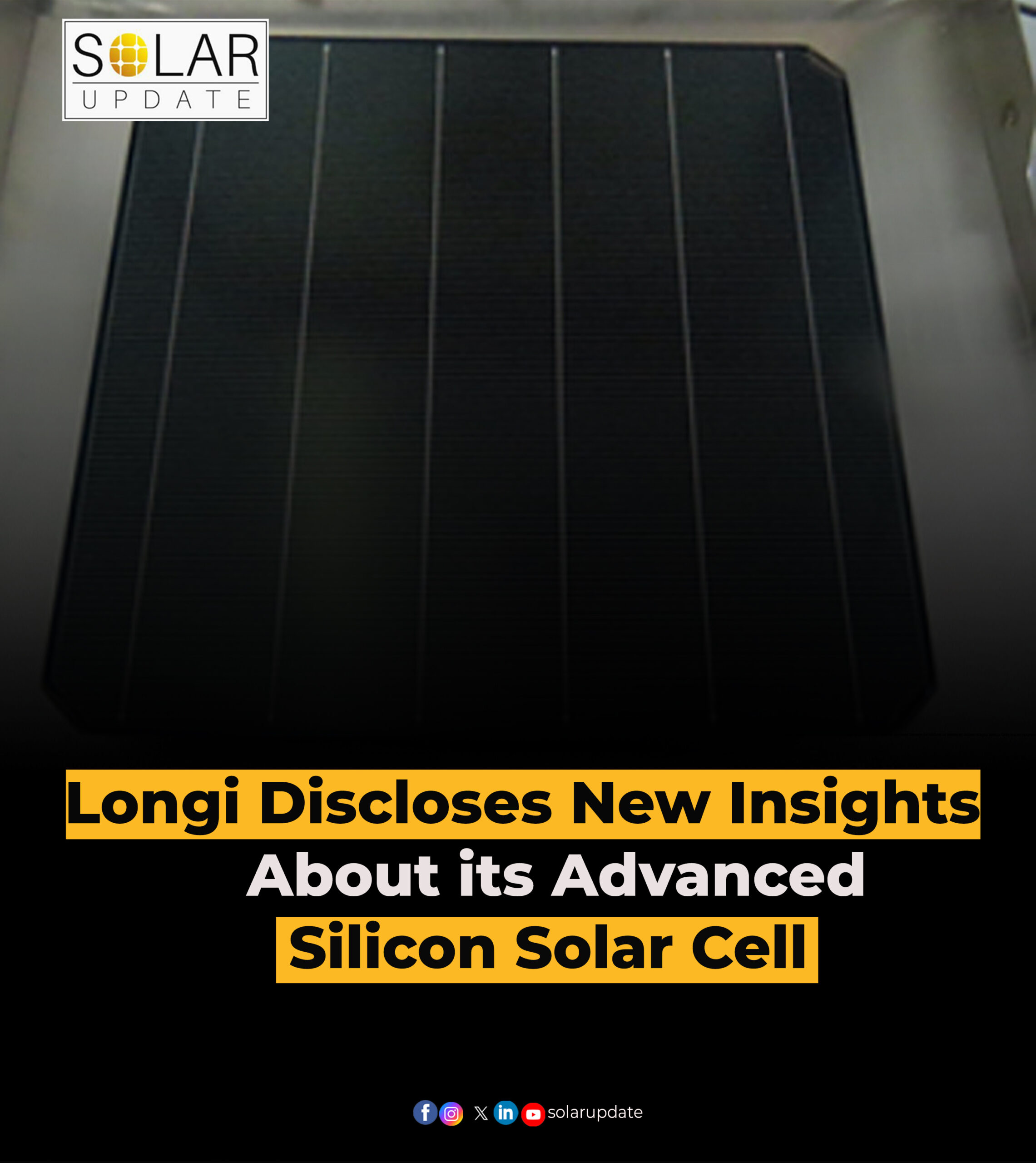
Longi initially announced that the device achieved the world’s highest efficiency for a silicon solar cell, with the result certified by Germany’s Institute for Solar Energy Research Hamelin (ISFH). At the time, a company spokesperson said that the breakthrough came from a complete redesign of the cell architecture and material systems, enabling simultaneous advances in optical management and carrier transport efficiency. No further technical details were disclosed then.
These details have now been revealed in the newly published Nature paper, “Silicon solar cells with hybrid back contacts.” The research team—led in part by Longi’s president and founder Li Zhenguo—explains that the record-setting device uses passivated tunnelling contacts, dielectric passivation layers, and incorporates both n-type and p-type contacts.
To build the cell, the scientists used a high-resistivity, half-cut M10 wafer with edge passivation. They developed an optimised n-type contact using a combined high–low temperature process, applied an indium tin oxide (ITO) layer to support lateral transport, and added a multilayer stack of aluminium oxide (AlOx) and silicon nitride (SiNx) on the textured front surface to suppress recombination. An amorphous silicon (a-Si) layer was also introduced.
Phosphorus doping in the n-type polycrystalline silicon (n-poly-Si) layer was reduced by an order of magnitude to minimize dopant diffusion. The researchers noted that the high–low temperature fabrication approach enables built-in wafer edge passivation—an approach known as in situ passivated edge technology (iPET).
They further used 8-μm deep trenched metal fingers for hole collection, combined with selective ITO removal to prevent leakage between n-type and p-type contacts. The a-Si layer was thickened to ensure complete p–i–n junction coverage and full encapsulation of the n-poly-Si sidewalls. To reduce contact resistivity, this layer was crystallised using a pulsed green nanosecond laser, chosen to preserve the edge passivation.
According to the team, optimising the balance between passivation and conductivity required precise control over the a-Si layer thickness, optical properties, and laser parameters—including fluence and pulse duration.
The device reached a world-record efficiency of 27.81% on a cell with an active area of 133.63 cm². It delivered a short-circuit current of 5,698 mA, an open-circuit voltage of 744.9 mV, and a fill factor of 87.55%.
The paper attributes this performance to the integration of several advanced techniques—including laser-induced crystallisation, in situ edge passivation, and optimized surface treatments—which collectively reduce the ideality factor to below 1 at maximum power point, significantly boosting the fill factor.
The ideality factor, which typically ranges from 1 to 2, measures how closely a solar cell behaves like an ideal diode.
Looking forward, Longi said these innovations can be scaled for heterojunction (HJT) manufacturing. However, the company noted that the p-type contact currently shows 50% higher resistive loss than the n-type contact, indicating room for improvement in contact resistivity.

Adapted from :https://www.pv-magazine.com/2025/11/20/longi-reveals-details-of-worlds-most-efficient-silicon-solar-cell/