





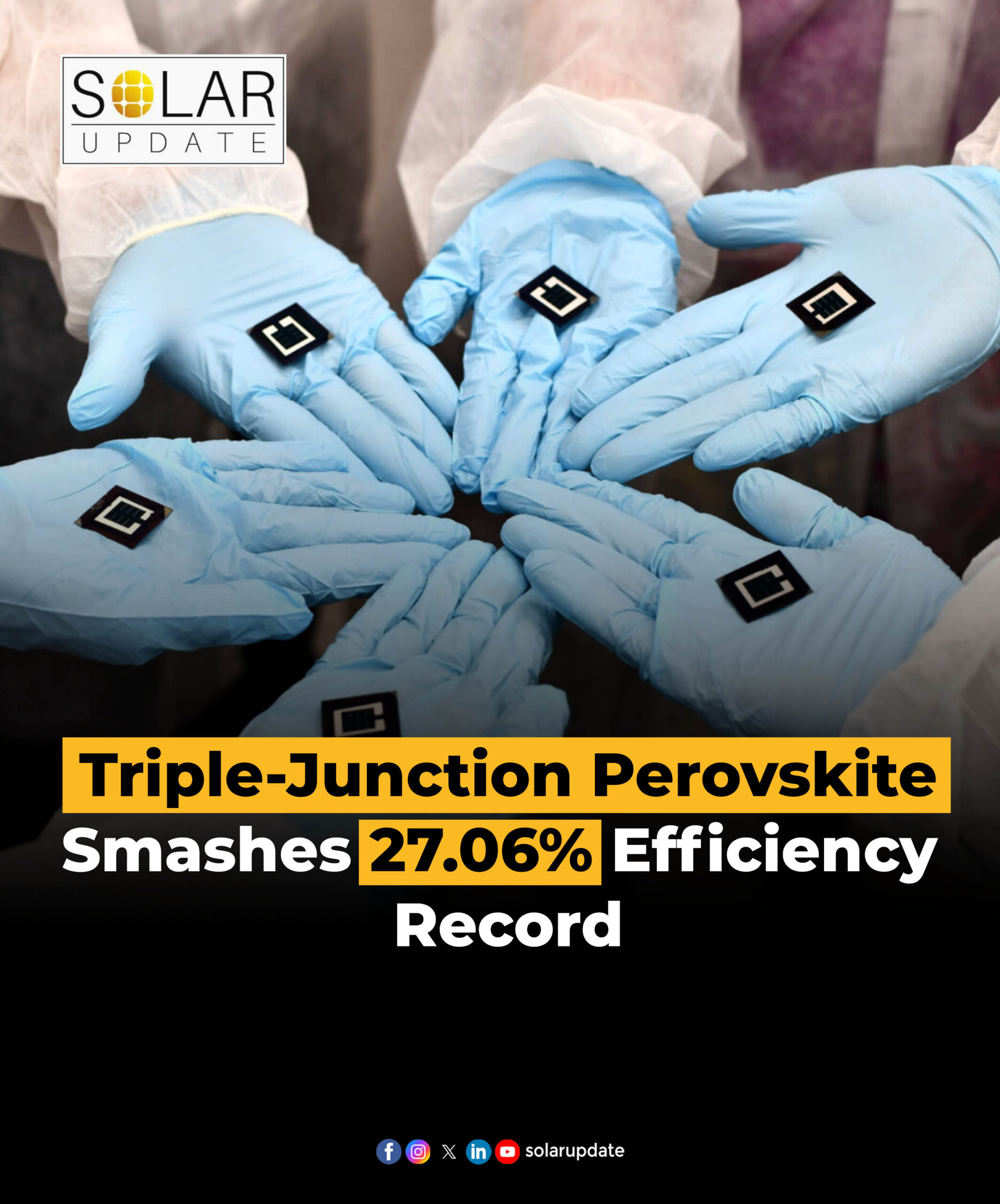
“We’ve achieved a record-breaking milestone in solar energy research,” said Professor Anita Ho-Baillie, Adjunct Professor at the University of Sydney and John Hooke Chair of Nanoscience at the University of Sydney Nano Institute and School of Physics. “Our team has created the largest and most efficient triple-junction perovskite–perovskite–silicon tandem solar cell yet reported, reaching an efficiency of 23.3% on a 16 cm² device.”
“At 1 cm², the triple-junction cell achieved 27.06% power conversion efficiency with an open circuit voltage of 3.16 V, and it retained **95% of its initial efficiency after more than 400 hours of continuous operation under light,” she explained. “For the first time globally, the encapsulated 1 cm² cell passed the International Electrotechnical Commission’s thermal cycling test, enduring 200 cycles of extreme temperature swings between -40 and 85 degrees Celsius.”
According to Ho-Baillie, the results demonstrate both high efficiency and durability — key steps toward overcoming barriers in developing and commercializing perovskite tandem solar cell technology. “This is the largest triple-junction perovskite device demonstrated so far, and it’s been rigorously tested and certified by independent laboratories,” she said. “That gives us confidence that this technology can be scaled for practical use.”
“Perovskites are already proving that we can exceed the efficiency limits of silicon alone,” Ho-Baillie continued. “These advances bring us closer to cheaper and more sustainable solar energy solutions that will power a low-carbon future.”
She explained that the achievement was made possible by re-engineering the chemistry of the perovskite material and redesigning the triple-junction cell. “We replaced methylammonium, which is commonly used in high-efficiency perovskite cells, with more stable rubidium, forming a perovskite lattice less prone to defects and degradation. We also introduced piperazinium dichloride instead of the less stable lithium fluoride as a new surface treatment.”
“To connect the two perovskite junctions, we used nanoscale gold deposited on atomic layer–deposited tin oxide,” she added. “This approach maximized both the flow of electric charge and light absorption by the solar cell.”
“We improved both performance and resilience,” Ho-Baillie concluded. “This not only shows that large, stable perovskite devices are achievable but also reveals the enormous potential for even greater efficiency gains in the future.”
The study, titled Tailoring nanoscale interfaces for perovskite–perovskite–silicon triple-junction solar cells, was conducted in collaboration with researchers from China, Germany, and Slovenia, with support from the Australian Renewable Energy Agency (ARENA) and the Australian Research Council (ARC).

https://www.pv-magazine-australia.com/2025/10/08/australian-researchers-achieve-27-06-efficiency-with-triple-junction-perovskite-solar-cell/